Printing methods
Silkscreen vs DTF vs sublimation: which print method for company t-shirts?
Silkscreen vs DTF vs sublimation comes down to your logo, your quantity and your shirt colour. For a larger order of custom company t-shirts, silkscreen is usually the best choice because it lasts the longest and is the most cost-effective at volume. DTF suits small quantities and full-colour designs, and sublimation gives an all-over print on light-coloured polyester.
This guide is for teams in Singapore and Malaysia planning company t-shirt printing. It compares the three methods, shows what each one cannot do, and lists what to prepare before you ask for a quote. Every order starts with a free design and mock-up, and our minimum order is 20 pieces.
What is the difference between silkscreen, DTF and sublimation?
| Feature | Silkscreen | DTF | Sublimation |
|---|---|---|---|
| Look | Solid colours, 1 to 4 | Full colour and gradients | Full-colour, all-over print |
| Best for | Larger quantities | Small quantities and detailed logos | All-over designs |
| Fabric | See each product page | See each product page | Polyester only |
| Garment colour | See each product page | See each product page | Light-coloured only |
| Watch out for | Not suitable for gradients, photos or many colours | Less long-lasting than silkscreen | Not suitable for dark garments |
Silkscreen vs DTF: which is better for company tees?
For larger quantities we usually recommend silkscreen. It lasts the longest, gives solid and consistent colours on every piece, and is the most cost-effective at volume. DTF suits small quantities and full-colour designs, but it is less long-lasting than silkscreen. Silkscreen is not suitable for gradients, photos or designs with many colours, so a multi-colour or photographic logo points to DTF.
When is silkscreen the best choice?
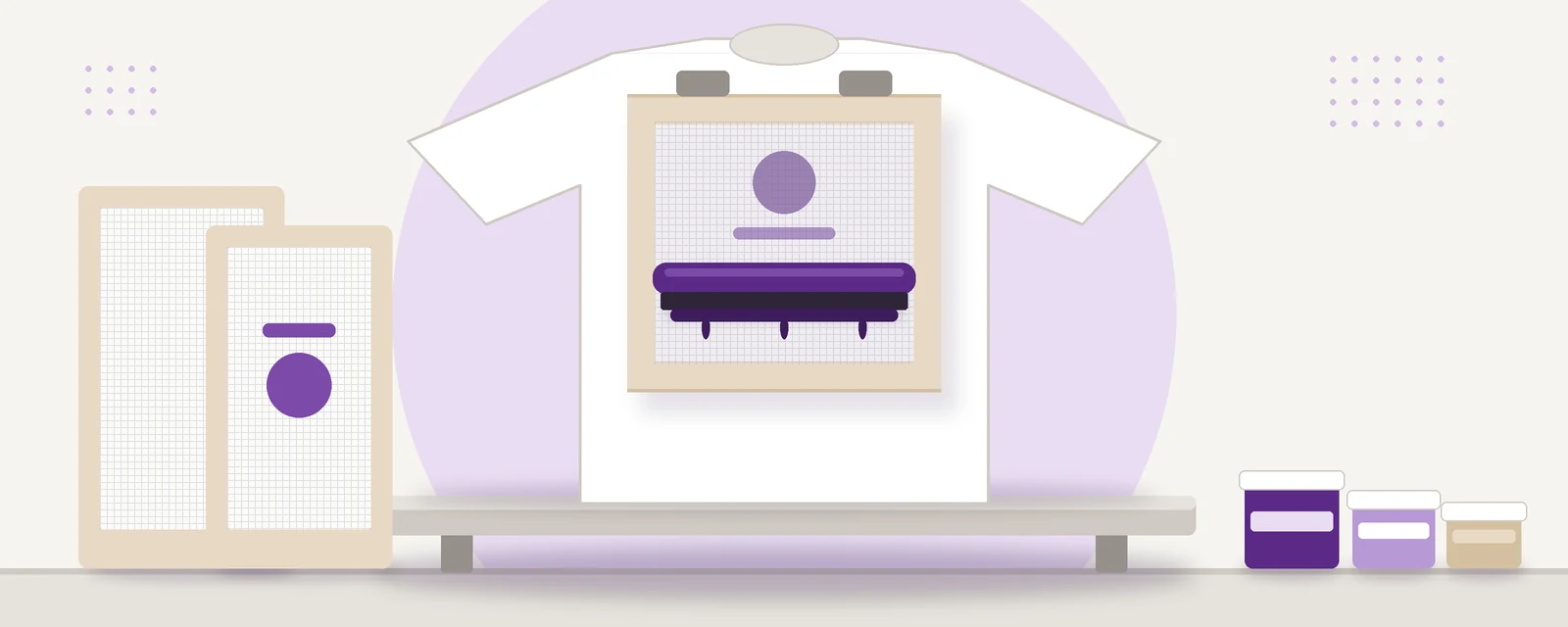
Silkscreen needs one mould per colour per print location, so fewer colours means a lower price. The mould is a one-time setup, so a larger quantity also lowers the price per piece. Our prices cover the product and the printing, including the silkscreen mould.
For larger quantities we usually recommend silkscreen. It gives solid, consistent colours on every piece and lasts the longest. The trade-off is that it is not suitable for gradients, photos or designs with many colours. Lines in your design should be at least 1 mm wide.
When should I choose DTF?
DTF is usually the best choice for full-colour designs and gradients, and it suits small quantities. Lines should be at least 2 mm wide. DTF is less long-lasting than silkscreen, so for a large order with a simple logo, silkscreen is usually the better fit.
If you want a name or number on each shirt, DTF is one of the methods that can add them, along with embroidery, sublimation and laser engraving. This costs a small additional charge per piece, and we include it in your quotation when you send us the list.
What can sublimation print on?
Sublimation gives an all-over print and works on polyester only, on light-coloured garments. It is not suitable for dark garments. Because it works on polyester only, it is not an option for a cotton tee.
Do you offer DTG and embroidery for tees?
For apparel we also offer DTG and embroidery.
- DTG: on a black shirt it needs a white base, which costs more.
- Embroidery: a premium stitched look that is popular for corporate wear. It supports up to 8 thread colours and is not suitable for gradients, fine detail or cuffs. Thin lines should be at least 2 mm.
Which method suits polos, uniforms and caps?
The same choice applies beyond t-shirts. Our tees page lists silkscreen, DTF, DTG, embroidery and sublimation (sublimation works on light-coloured polyester only), with 57 tees to choose from. Our 53 polos all offer embroidery, along with silkscreen and DTF, and embroidery is popular for corporate wear. Uniforms and workwear, 30 products, list silkscreen, DTF and embroidery, and caps and hats list embroidery and DTF, with silkscreen on selected models. Each product page lists its own logo options.
How do I match the method to my shirt?
Garment colour narrows the choice, so tell us yours when you ask and we will recommend the right method.
Fabric matters too. Our CT21 and CT24 cotton shirts use premium 42-count cotton, all our dri-fit shirts are made from recycled plastic bottles, and we also have organic cotton options. As an example, the Siro Comfort Cotton Tee (CT21) is 100% cotton interlock, 210 gsm, in sizes XS to 4XL and 30 colours.
If budget matters most, our budget range includes CT16E (black and white only), DF01E, HD28E and WB01E.
Each shirt model is dyed in a separate batch, so colour may vary slightly between models. We can arrange a sample first if the colour match matters to you.
What should I prepare before asking for a quote?
- Quantity, purpose and deadline. The price depends on quantity, printing method and number of colours. Our standard lead time is 2 to 3 weeks after artwork and payment confirmation.
- Your logo file. Ideally 300 dpi or above with a transparent background, sent as a zip file in PNG, AI or PSD format. A Canva link also works. If you only have a low-quality file, we can redraw and trace your logo.
- Print size. A5 is up to 14 x 20 cm, A4 is up to 20 x 28 cm and A3 is up to 28 x 40 cm.
- Brand colour. Send a Pantone code if you have one. If not, we can match it using our colour card.
- Garment colour, as above.
What is the next step?
Send your logo, rough quantity and shirt colour. Your mock-up is usually ready on the same working day, and we will reply as soon as we can. You can ask for as many mock-up revisions as you need before anything is produced.
Browse custom tees and custom company polos, or read the FAQ. Printing shirts for a class or event? See our guide to school event t-shirts and student council shirts. Not sure what to send first? Read how a free mock-up works.
Frequently asked questions
Which is better, silkscreen or DTF?
For larger quantities we usually recommend silkscreen. It lasts the longest, gives solid and consistent colours on every piece, and is the most cost-effective at volume. DTF suits small quantities and full-colour designs, but it is less long-lasting than silkscreen.
Which method is best for gradients or photos?
DTF is usually the best choice for full-colour designs and gradients. Sublimation also works for all-over full-colour prints on polyester. Silkscreen is not suitable for gradients, photos or designs with many colours.
What is sublimation printing?
Sublimation gives an all-over print and works on polyester only, on light-coloured garments.
Can you print on dark garments?
It depends on the method. Sublimation is not suitable for dark garments, and DTG on a black shirt needs a white base, which costs more. Tell us your garment colour and we will recommend the right method.
What is the minimum order for company t-shirt printing?
Our minimum order is 20 pieces.